



What happens when technology becomes the defining factor in a modern family SUV? Not bigger screens. Not more features stacked into menus. Not a spec-sheet arms race. The real shift happens when technology fades into the background—when it begins to support the driving experience instead of competing with it.
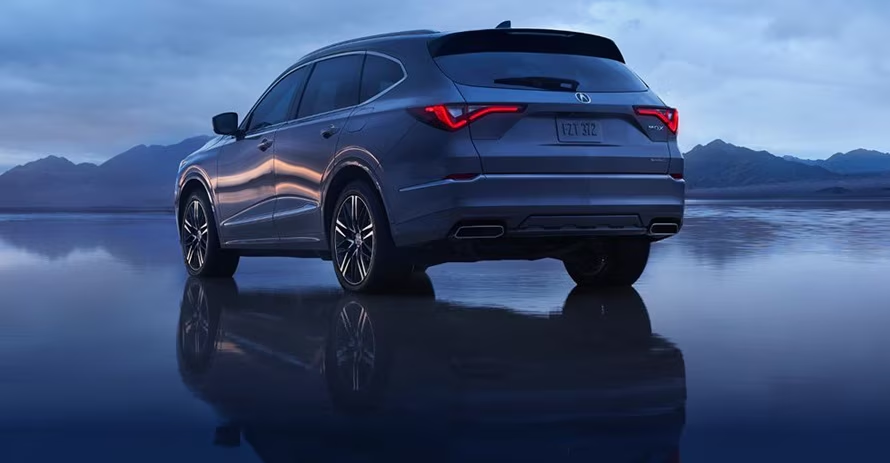
That’s the space the 2025 Acura MDX now occupies.
Rather than chasing novelty, Acura has taken a more disciplined approach. This latest iteration of its three-row flagship doesn’t attempt to reinvent itself. Instead, it refines the fundamentals with a clear objective: make everyday driving easier, more intuitive, and less mentally taxing.
A Measured Evolution, Not a Reinvention
In a segment where updates often mean radical redesigns or headline-grabbing features, the MDX takes a quieter path. Its changes are subtle but purposeful, focusing on the friction points that matter most to owners over time.
This is not a vehicle engineered to impress during a 15-minute test drive. It’s designed to deliver consistency over years of daily use—school runs, highway commutes, road trips, and everything in between.
That distinction matters more than ever in the midsize luxury SUV category, where expectations have shifted from raw capability to seamless integration.

Fixing the Interface: Technology That Finally Feels Natural
One of the most notable improvements in the 2025 MDX centers on its infotainment system—a longtime pain point in earlier versions. Acura has reworked the interface to improve responsiveness, clarity, and overall usability.
The difference is immediately apparent. Inputs register more quickly, menus are easier to navigate, and the system requires less cognitive effort to operate. This is not just a technical upgrade; it’s a philosophical one.
Too many modern vehicles overwhelm drivers with layered menus and excessive customization. The MDX takes a more restrained approach, prioritizing intuitive interaction over feature density. Controls feel deliberate, not distracting.
In practice, that means less time glancing at screens and more time focused on the road—exactly what a family-oriented SUV should deliver.
Driver Assistance That Knows Its Place
Advanced driver assistance systems have become standard in this segment, but execution varies widely. Some systems feel intrusive or overly sensitive, while others fail to inspire confidence.
The 2025 MDX strikes a careful balance.
Adaptive cruise control, lane-keeping assistance, and safety monitoring systems operate more cohesively, working in the background rather than demanding constant attention. The improvements aren’t about adding capability—they’re about refining behavior.
There’s a noticeable reduction in abrupt inputs and unnecessary alerts. Instead of feeling like a co-pilot that second-guesses every move, the system acts more like a quiet assistant, stepping in only when needed.
On long highway drives or in heavy traffic, this translates to reduced fatigue. And that’s where the real value lies—not in what the system can do, but in how unobtrusively it does it.
Road Manners That Prioritize Confidence
Behind the wheel, the MDX remains true to its identity. It doesn’t attempt to disguise its size or pretend to be a sport sedan. Instead, it leans into stability, predictability, and control.
Steering is precise enough to inspire confidence without feeling overly sharp. The suspension is tuned for composure, absorbing imperfections while maintaining a planted feel at speed. Body motions are well-managed, particularly during highway driving and sweeping turns.
This is not the most athletic SUV in its class, and it doesn’t need to be. Acura has clearly prioritized comfort and control over outright sportiness, resulting in a driving experience that feels consistent and reassuring.
For families, that predictability is more valuable than dynamic flair.
Interior Space That Works in the Real World
The MDX continues to excel where it matters most for its target audience: usability.
All three rows are genuinely functional, not just theoretical. The second row offers ample room for passengers, while the third row remains accessible and practical for both children and adults on shorter trips.
Cargo flexibility is another strength. Thoughtful storage solutions and configurable seating make it easy to adapt the interior for different needs, whether it’s hauling luggage, groceries, or sports equipment.
Material quality reinforces Acura’s premium positioning without tipping into excess. Surfaces feel durable yet refined, striking a balance that aligns with the vehicle’s everyday mission.
This is a cabin designed for use, not just presentation.
The Subtle Advantage: Technology That Disappears
Here’s what ultimately defines the 2025 MDX—and what many drivers may not immediately recognize.
Its greatest strength is not what it adds, but what it removes.
It reduces the small frustrations that accumulate over time: laggy interfaces, confusing controls, overly aggressive driver aids. In their place is a more cohesive, less intrusive experience.
The technology doesn’t demand attention. It doesn’t try to impress passengers or dominate the dashboard. Instead, it integrates seamlessly into the driving routine, becoming almost invisible.
That’s a rare achievement in a market increasingly driven by digital excess.
A Different Kind of Progress
The 2025 Acura MDX represents a shift in how progress is measured in the automotive world. It’s not about introducing groundbreaking features or redefining the segment overnight.
It’s about refinement.
It’s about understanding that true innovation often lies in execution rather than invention. By focusing on usability, Acura has created a vehicle that feels more complete—not because it does more, but because it does everything better.
In a crowded field of luxury SUVs competing for attention, the MDX takes a more confident approach. It doesn’t need to shout. It simply works.
And for many buyers, that may be the most compelling feature of all.


