



What happens when a performance sedan is engineered not to impress on paper, but to excel where it matters most—behind the wheel and over time? That question sits at the heart of the Hyundai Ioniq 6 N, a car that takes a decidedly different path in an increasingly numbers-obsessed segment.
In a landscape dominated by headline-grabbing horsepower figures and sub-three-second acceleration claims, Hyundai’s N division has quietly shifted the conversation. Instead of chasing shock value, the Ioniq 6 N is built around control, consistency, and driver engagement—qualities that reveal themselves not in a single burst of acceleration, but across every mile driven.
A New Philosophy of Performance
For decades, performance sedans have followed a predictable formula: more power, sharper styling, and increasingly aggressive dynamics. But with the transition to electrification, that formula has begun to show its limitations. Instant torque is no longer a differentiator—it’s a given.
The Ioniq 6 N recognizes this shift and responds with a more nuanced approach. Power delivery is immediate, as expected from a modern EV, but it’s also carefully calibrated. There’s a measured quality to the acceleration that makes it accessible rather than overwhelming. It’s quick—undeniably so—but never chaotic.
This restraint is not a limitation; it’s a deliberate engineering choice. By prioritizing modulation over raw output, Hyundai has created a car that encourages drivers to explore its performance envelope with confidence.
Chassis Tuning That Builds Trust
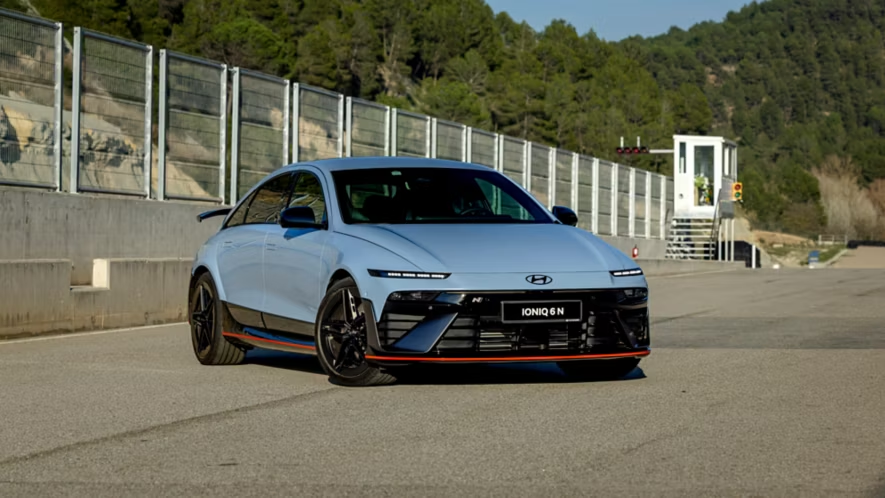
If the powertrain sets the tone, the chassis defines the experience. And here, the Ioniq 6 N distinguishes itself with remarkable clarity.
The car feels planted in a way that immediately inspires trust. There’s a cohesiveness to how the suspension, steering, and weight distribution interact, creating a sense of intentionality that’s often missing in high-performance EVs. Instead of relying on brute force or artificial drama, the chassis communicates.
Steering feedback is precise and consistent, offering just enough detail to keep the driver informed without becoming overly sensitive. The suspension tuning strikes a careful balance between compliance and control, absorbing imperfections without sacrificing composure.
As speeds rise and corners tighten, the car remains predictable. There are no sudden surprises, no moments where the vehicle feels like it’s operating beyond the driver’s control. That predictability is what transforms speed into confidence—and confidence into enjoyment.
Real-World Performance, Not Theoretical Limits
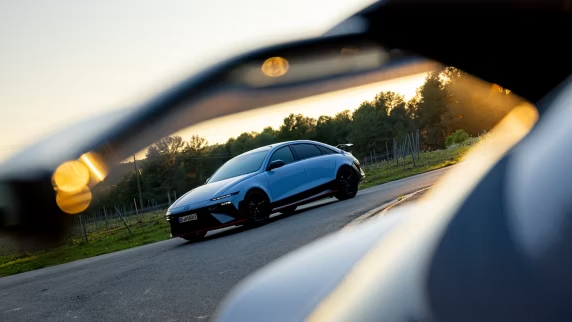
What truly sets the Ioniq 6 N apart is how it performs outside of controlled environments. On real roads—where surfaces vary, traffic intervenes, and conditions are rarely ideal—the car’s balanced nature becomes its defining characteristic.
This is not a sedan that demands constant attention or punishes imperfect inputs. Instead, it rewards smoothness and precision. Drivers who take the time to understand its responses will find a car that feels intuitive, almost cooperative.
In daily driving, that translates to a level of usability that many performance-focused vehicles struggle to achieve. The ride remains composed, the controls remain intuitive, and the overall experience feels cohesive rather than segmented between “comfort” and “sport” modes.
It’s a reminder that true performance isn’t just about peak capability—it’s about how often and how easily that capability can be accessed.
Moving Beyond Spec-Sheet Rivalries
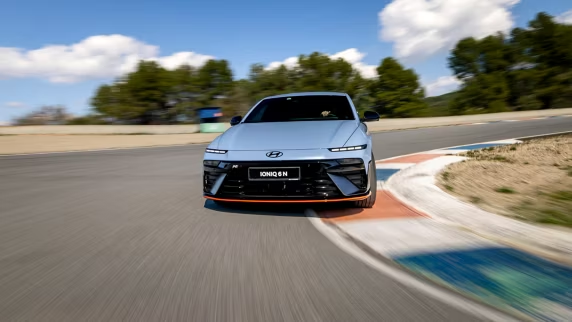
Perhaps the most compelling aspect of the Ioniq 6 N is what it chooses not to do. It doesn’t chase rivals in a race for dominance on paper. There’s no obsession with claiming the highest output or the fastest acceleration time in its class.
Instead, Hyundai has focused on defining what a modern performance sedan should feel like as a complete experience. That distinction matters more than ever in the EV era, where traditional benchmarks are rapidly becoming less meaningful.
By emphasizing balance, the Ioniq 6 N challenges the assumption that more is always better. It suggests that refinement, control, and driver connection are just as important—if not more so—than raw performance figures.
The Evolution of the Performance Sedan
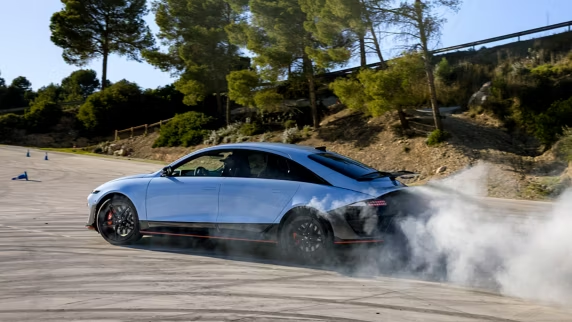
The arrival of the Ioniq 6 N signals a broader shift in how performance is being redefined. As electric vehicles continue to reshape the automotive landscape, the qualities that once defined enthusiast cars are being reevaluated.
Hyundai’s N division, which has already built a reputation for delivering engaging driving experiences in models like the Hyundai Elantra N, appears to be carrying that philosophy into the electric age with remarkable discipline.
The result is a car that feels less like a technological showcase and more like a driver’s tool—one that prioritizes interaction over intimidation.
Why Balance Is the New Benchmark
The most important takeaway from the Ioniq 6 N isn’t a number or a specification. It’s a philosophy.
When a car is engineered around balance—when every system is tuned to work in harmony—the entire driving experience changes. Speed becomes more approachable, handling becomes more intuitive, and the car itself becomes more enjoyable to live with.
This is where the Ioniq 6 N makes its strongest case. It doesn’t try to overwhelm or impress in fleeting moments. Instead, it builds a lasting connection with the driver, one that grows stronger with time and familiarity.
And once that becomes the benchmark, many traditional performance cars begin to feel out of step—overly aggressive, unnecessarily complicated, or simply less cohesive.
A Quiet Revolution in Motion
The Hyundai Ioniq 6 N may not be the loudest or most extreme entrant in the performance sedan segment, but that’s precisely the point. Its strength lies in its restraint, its clarity of purpose, and its commitment to delivering a complete driving experience.
In doing so, it redefines what enthusiasts should expect from a modern performance car—not just in terms of speed, but in how that speed is delivered, controlled, and ultimately enjoyed.


