



In a segment increasingly defined by spec-sheet one-upmanship, the most interesting electric cars are often the ones that refuse to play that game. Range figures stretch higher, acceleration times shrink lower, and design grows ever more experimental. Yet for many drivers, the real question isn’t how far an EV can go on a single charge or how quickly it can hit 100 km/h—it’s how naturally it fits into daily life.
That’s precisely where Hyundai’s upcoming compact electric hatchback takes a different path. Instead of chasing extremes, it focuses on balance. And in doing so, it may address one of the most overlooked gaps in the current EV market: making electric mobility feel ordinary in the best possible way.
A Shift Away From the Numbers Game
Affordable electric vehicles have largely followed a predictable formula. Efficiency is prioritized above all else, often at the expense of driver engagement. Interiors lean toward minimalism, sometimes to a fault, while driving dynamics are tuned for maximum range rather than responsiveness.
Hyundai’s approach signals a subtle but meaningful shift. This compact hatchback isn’t being positioned as a technological showcase or a range leader. Instead, it aims to deliver a well-rounded experience—one that doesn’t require drivers to recalibrate their expectations every time they get behind the wheel.
That distinction matters. As EV adoption expands beyond early adopters, the target audience is no longer looking for novelty. They’re looking for familiarity, reliability, and ease of use. Hyundai appears to understand that the next phase of electrification won’t be driven by innovation alone, but by how seamlessly these vehicles integrate into everyday routines.

Designed for the Real World
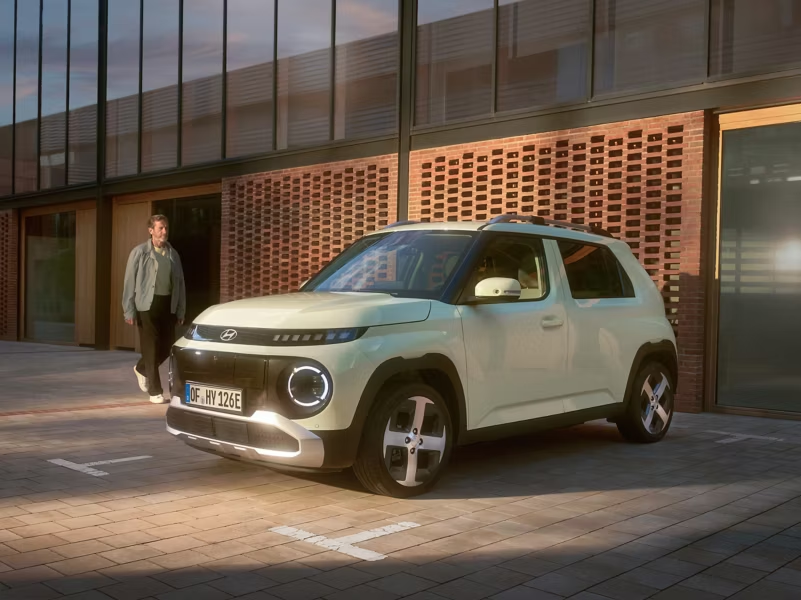
The strength of a small hatchback has always been its practicality, and that formula translates naturally to the electric era. Compact dimensions make urban driving less stressful, whether navigating congested streets or squeezing into tight parking spaces. A smaller footprint also tends to result in a lighter vehicle, which can improve efficiency without relying solely on battery size.
Hyundai’s tuning philosophy reinforces this real-world usability. Rather than delivering abrupt bursts of torque or overly aggressive throttle responses, the focus is on smooth, predictable power delivery. This kind of calibration makes a difference in stop-and-go traffic, where consistency and control matter more than outright performance.
Steering, too, plays a crucial role. In many budget EVs, it’s an afterthought—overly light, vague, and disconnected. Here, the goal appears to be something more intuitive. A steering setup that responds naturally to driver inputs can transform the driving experience, making the car feel more manageable in tight spaces and more composed at higher speeds.
Engagement Without Complexity
One of the more intriguing aspects of this approach is how it redefines driver engagement. In traditional enthusiast terms, engagement often means power, speed, and dynamic extremes. But in an urban electric hatchback, engagement can take on a different meaning.
It’s about how the car responds to everyday inputs. How smoothly it accelerates from a standstill. How confidently it handles a quick lane change. How predictable it feels when navigating uneven road surfaces or crowded intersections.
By focusing on these subtleties, Hyundai is effectively lowering the barrier to entry for EV ownership. Drivers don’t need to learn new behaviors or adapt to unconventional controls. The experience is designed to feel familiar from the outset, which can be a decisive factor for buyers transitioning from internal combustion engines.
The Importance of Normalcy in EV Adoption
There’s a tendency in the automotive industry to equate progress with disruption. New platforms, radical designs, and cutting-edge features dominate headlines. But widespread adoption often depends on something far less glamorous: comfort.
For many consumers, the hesitation around electric vehicles isn’t rooted in skepticism about the technology itself. It’s about uncertainty. Charging infrastructure, range anxiety, and long-term usability all play a role, but so does the simple question of how different an EV feels to drive and live with.
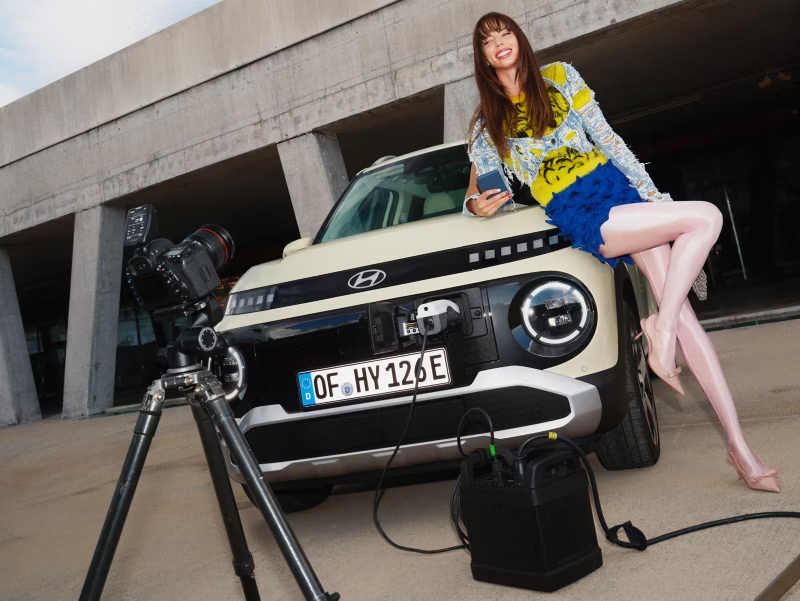
By prioritizing normalcy, Hyundai’s compact hatchback addresses that concern directly. It doesn’t ask drivers to rethink their relationship with the car. Instead, it offers a familiar experience with the added benefits of electrification—quiet operation, instant torque, and reduced running costs.
This strategy could prove especially effective in markets where small hatchbacks remain a dominant choice. In these regions, buyers are already accustomed to compact dimensions and practical layouts. An electric alternative that preserves those strengths while minimizing compromises has the potential to resonate strongly.
A Broader Industry Implication
Hyundai’s direction also reflects a broader shift within the industry. As EV technology matures, differentiation is becoming less about hardware and more about execution. Battery performance and charging speeds are converging across manufacturers, making driving experience and usability key battlegrounds.
In that context, a balanced, approachable electric hatchback isn’t just a niche offering—it’s a strategic move. It acknowledges that the future of electric mobility won’t be defined solely by flagship models or high-performance variants, but by the vehicles people use every day.
Conclusion: Quietly Redefining What Matters
There’s a quiet confidence in Hyundai’s approach. By resisting the urge to chase extremes, this compact electric hatchback focuses on the fundamentals: usability, predictability, and everyday comfort. It’s not trying to reinvent the wheel—it’s trying to make sure the wheel feels right in the first place.
And that may ultimately be more important than any headline-grabbing statistic. Because for electric vehicles to truly go mainstream, they don’t just need to impress—they need to fit in.


