



What does it mean for an enthusiast nameplate to return in an era defined less by horsepower wars and more by efficiency mandates? For Honda Prelude, the answer isn’t rooted in nostalgia—it’s rooted in evolution.
Honda’s decision to revive the Prelude is not an attempt to relive the past. Instead, it’s a deliberate recalibration of what an accessible driver’s car can be in a hybridized, increasingly electrified world. Where earlier generations built their reputation on rev-happy engines and balanced chassis tuning, the new Prelude carries that DNA forward—but interprets it through a modern lens shaped by efficiency, usability, and restraint.
A Different Kind of Performance Philosophy
In an age where performance headlines are dominated by 0–60 times and output figures, the Prelude takes a notably different approach. Rather than chasing outright speed, Honda has leaned into a philosophy centered on harmony between driver and machine.
The hybrid powertrain is the clearest expression of that shift. Electric assistance is not there to overwhelm the internal combustion engine, but to enhance it. Throttle inputs are met with smooth, linear responses. Power delivery feels progressive rather than explosive. The result is a driving experience that prioritizes predictability and control over raw acceleration.
This is not a car engineered to intimidate or impress in short bursts. It’s engineered to feel right over time.
That distinction matters, particularly for a new generation of drivers who may be entering enthusiast territory through electrified platforms rather than traditional performance cars.

Precision Over Aggression
Behind the wheel, the Prelude’s character becomes even more defined. Steering is light, but not vague. There’s a clarity to the inputs that makes the car feel intuitive, even at moderate speeds. Body motions are well-managed, giving the chassis a sense of composure that encourages confidence.
This is not a car that demands constant correction or punishes imperfect inputs. Instead, it rewards smoothness and consistency. The balance is deliberate—approachable for less experienced drivers, yet engaging enough to maintain the interest of seasoned enthusiasts.
That duality has always been central to the Prelude’s identity. The difference now is how it’s delivered. Where older models leaned more heavily on mechanical simplicity, the 2026 version integrates technology without letting it dominate the experience.
The result is a car that feels modern, but not synthetic.
Design That Speaks Quietly
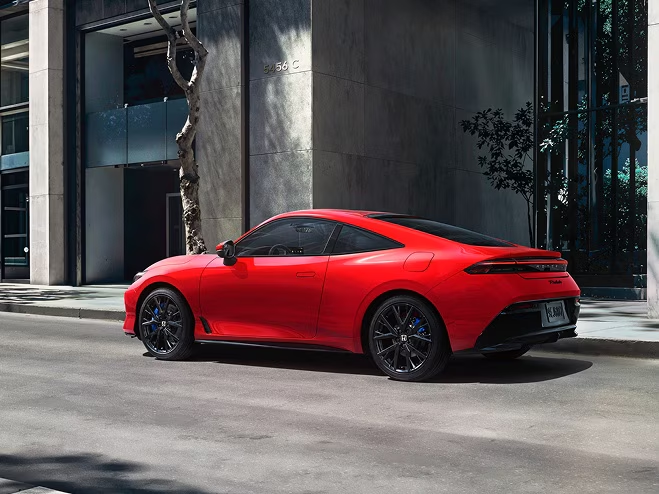
Visually, the new Prelude resists the temptation to overcompensate. In a market saturated with aggressive styling cues and exaggerated proportions, its design stands apart through restraint.
The coupe silhouette remains central to its identity. A low roofline, clean body surfacing, and balanced proportions give it a purposeful stance without relying on visual theatrics. There are no unnecessary creases or oversized aerodynamic elements competing for attention.
It’s a design that feels confident in its simplicity—arguably a reflection of the car’s broader philosophy.
That approach also positions the Prelude as something increasingly rare: a compact coupe that prioritizes elegance and proportion over trend-driven styling.

A Driver-Focused Interior Without the Noise
Inside, the same philosophy continues. The cabin is organized around usability, not spectacle.
Controls are logically placed, minimizing distraction. The seating position is supportive without being overly aggressive, striking a balance between daily comfort and spirited driving capability. Technology is present, but it doesn’t dominate the experience.
In many ways, this is where the Prelude makes one of its strongest statements. As interiors across the industry trend toward larger screens and increasingly complex interfaces, Honda has chosen to maintain clarity and accessibility.
It’s a reminder that innovation doesn’t always require adding more—it can also mean refining what already works.
Reframing the Role of the Enthusiast Car
Perhaps the most significant aspect of the Prelude’s return is what it represents beyond its specifications.
This is not a halo car. It’s not intended to redefine performance benchmarks or compete with high-end sports cars. Its purpose is more foundational: to reintroduce the idea of driving enjoyment in a way that aligns with contemporary expectations.
For decades, entry-level enthusiast cars served as a gateway—accessible platforms that prioritized feel, balance, and driver engagement. As the industry has shifted toward electrification and crossovers, that entry point has become less defined.
The Prelude aims to fill that gap.
By integrating hybrid technology into a driver-focused coupe, Honda is effectively redefining what “entry-level enthusiasm” looks like. It acknowledges the realities of modern regulations and consumer preferences, while still preserving the elements that make driving rewarding.
That balance is not easy to achieve. But it may be exactly what the segment needs.
Not the Fastest, But Possibly the Most Relevant
It’s easy to measure a car’s success through performance metrics. In that context, the Prelude is unlikely to dominate headlines. It won’t be the fastest car in its class, nor the most powerful.
But those metrics miss the point.
The significance of the Prelude lies in its intent. It demonstrates that driving enjoyment can coexist with efficiency. That engagement doesn’t have to be sacrificed in the transition to electrified powertrains.
More importantly, it suggests that the enthusiast car is not disappearing—it’s evolving.
For buyers who value connection over outright speed, and for a new generation discovering what it means to enjoy driving, the 2026 Prelude may prove to be one of the most important cars of its time.


